Last updated: October 21, 2026
Trap bar vs barbell deadlift is really a question about which bar to buy first, and the answer depends on one thing: whether you own, or plan to own, a squat rack. If you do, buy a straight Olympic barbell first, because it is the only bar that squats, benches, presses, rows and deadlifts. If you train without a rack, want the safest way to pull heavy, or mainly care about deadlifts, carries and conditioning, buy a trap bar first. The research is clear that both bars work the same muscles to a very similar degree: in the study Stronger by Science summarizes, lifters pulled 8.4 percent more with the trap bar, the barbell loaded the lower back and hips about 8 to 9 percent harder at the same weight, and the trap bar roughly doubled the demand on the quads. Neither bar is the “real” deadlift; they are two versions of the same hinge.
This guide compares and ranks the two bars on muscles worked, loading, learning curve, versatility, space, bar weight and what each costs to own, then names the one trap bar and the two barbells we would start a home gym with, drawn from our best trap bars for a home gym and Olympic barbells compared rankings. Both bars take the same 2 in Olympic plates, so your plate choice (see bumper plates vs iron plates) is the same either way.
Quick verdict
Rack owners: barbell first. No rack, or deadlifts and carries are the goal: trap bar first.
The CAP Olympic Trap Bar with dual handles is the trap bar to start with: 750 lb rating, raised and flush handles, 9 in sleeves. The Titan Fitness TITAN Series 20 kg bar is the barbell to start with: 190,000 PSI, 28.5 mm, bronze bushings, Cerakote. Most garage gyms end up owning both.
| Product | Best for | Key spec | |
|---|---|---|---|
| CAP Olympic Trap Bar (dual handle) | Best first trap bar: two handle heights and a 750 lb rating at a budget price | Closed hex, raised and flush neutral-grip handles, 750 lb listed capacity, 25 in interior opening, 9 in loadable sleeves, 52 lb bar, 56 x 24 in footprint | Check price at Amazon |
| Titan Fitness TITAN Series 20 kg Olympic Bar | Best first barbell: a 190,000 PSI bushing bar you can rack, squat, bench and deadlift with | 28.5 mm shaft, 190,000 PSI tensile, bronze bushings, medium volcano knurl with no center knurl, Cerakote shaft, 1,500 lb rating, 86.6 in long, 15.5 in sleeves | Check price at Amazon |
| Synergee Games 20 kg Bar | Best value barbell: the same tensile rating on a faster-spinning bearing shaft | 28 mm shaft, 190,000 PSI tensile, 10 needle bearings, 1.2 mm medium diamond knurl, no center knurl, Cerakote, dual IWF and IPF marks | Check price at Amazon |
| Bells of Steel Open Trap Bar | Best trap bar if it will be your main bar: open front, rotating sleeves and a built-in jack | Open front, rotating Olympic-style sleeves, 700 lb listed capacity, built-in jack for plate changes, 47 lb bar, 59 x 22.2 in, ships assembled | Check price at Amazon |
Quick picks
- Best first trap bar: two handle heights and a 750 lb rating at a budget price: CAP Olympic Trap Bar (dual handle), Closed hex, raised and flush neutral-grip handles, 750 lb listed capacity, 25 in interior opening, 9 in loadable sleeves, 52 lb bar, 56 x 24 in footprint.
- Best first barbell: a 190,000 PSI bushing bar you can rack, squat, bench and deadlift with: Titan Fitness TITAN Series 20 kg Olympic Bar, 28.5 mm shaft, 190,000 PSI tensile, bronze bushings, medium volcano knurl with no center knurl, Cerakote shaft, 1,500 lb rating, 86.6 in long, 15.5 in sleeves.
- Best value barbell: the same tensile rating on a faster-spinning bearing shaft: Synergee Games 20 kg Bar, 28 mm shaft, 190,000 PSI tensile, 10 needle bearings, 1.2 mm medium diamond knurl, no center knurl, Cerakote, dual IWF and IPF marks.
- Best trap bar if it will be your main bar: open front, rotating sleeves and a built-in jack: Bells of Steel Open Trap Bar, Open front, rotating Olympic-style sleeves, 700 lb listed capacity, built-in jack for plate changes, 47 lb bar, 59 x 22.2 in, ships assembled.
What is the difference between a trap bar and a barbell deadlift?
With a barbell deadlift the bar sits in front of your shins and you pull it up your legs with an overhand, mixed or hook grip. The load is a few inches in front of your center of mass the whole way, which is why the lift is hip-dominant: your hips and lower back do most of the work and your quads do relatively little. The straight bar is also the bar used in powerlifting meets and in every barbell program, so a barbell deadlift transfers directly to the sport version of the lift.
With a trap bar deadlift (hex bar deadlift) you stand inside a hexagonal or open frame and pull from neutral-grip handles at your sides. The load is in line with your body rather than in front of it, so you can sit the hips lower, keep the torso more upright and let the knees bend more. Most trap bars have two sets of handles: raised handles, which shorten the pull by a few inches and are easier on the back and hips, and flush handles, which put the hands at straight-bar height. The lift is the same hinge pattern; it just allows more freedom in how you share the work between hips and knees.
What the research says: hips, knees and lower back
The clearest comparison comes from a 2011 study by Swinton and colleagues, which Stronger by Science summarizes in its article on trap bar deadlifts. Trained lifters pulled the same absolute loads with both bars, from 10 to 80 percent of their barbell max, and the researchers measured the peak turning forces (moments) at the hip, knee and spine. The numbers worth remembering:
- Load: the lifters’ trap bar maxes were 8.4 percent higher than their barbell maxes (584 lb against 539 lb on average).
- Hips and lower back: at the same weight, the barbell produced a 9.2 percent higher peak spinal flexion moment and an 8.4 percent higher peak hip moment. In plain terms the straight bar loads the lower back and hips a little harder, and the trap bar a little less, at equal weight. At equal effort (each bar at 80 percent of its own max) the difference would mostly vanish.
- Knees: the peak knee moment was 182.5 Nm with the trap bar against 96 Nm with the barbell, almost double. That is the extra quad work people feel on a trap bar.
- Range of motion: hip and knee ranges of motion were within 2 to 6 degrees of each other, so the trap bar deadlift is still a hinge, not a squat. The hip-to-knee ratio was 3.68 to 1 for the barbell and 1.78 to 1 for the trap bar; a true back squat sits near 0.83 to 1.
Muscle activation studies point the same way: quad activity runs a little higher with the trap bar, hamstring and spinal erector activity a little higher with the straight bar, and the glutes work hard with both. If your goal is a stronger posterior chain and bigger pulling numbers, either bar gets you there; if your goal is a bigger barbell deadlift specifically, you need to practice with a barbell.
Trap bar vs barbell: side-by-side comparison
| Factor | Trap bar | Barbell |
|---|---|---|
| Muscles emphasized | Glutes, hamstrings, back, plus more quads | Glutes, hamstrings, lower back, with less quad |
| How much you can lift | About 8 percent more (Swinton 2011) | Baseline |
| Lower-back load at equal weight | About 9 percent lower peak spinal moment | Higher |
| Learning curve | Easy: neutral grip, upright torso, bar cannot drift forward | Harder: bar path, hip height and grip all have to be learned |
| Grip | Neutral handles; no mixed or hook grip needed | Overhand, mixed or hook grip; grip is often the limit |
| Other lifts | Shrugs, carries, rows, RDLs, jump squats; open bars add lunges and presses | Squat, bench, overhead press, rows, cleans, every rack lift |
| Works with a rack | No | Yes |
| Competition lift | No (Army ACFT uses it) | Yes (powerlifting) |
| Bar weight | 22 to 60 lb depending on model (CAP dual handle 52 lb) | 20 kg (44 lb) for a men’s Olympic bar |
| Footprint | About 56 x 24 in (closed hex) | About 87 in (7 ft 3 in) long, needs about 8 ft of wall |
| Plates | 2 in Olympic plates | 2 in Olympic plates |
Research figures from the Swinton 2011 study as summarized by Stronger by Science; bar weights and footprints from the makers’ Amazon listings linked in this guide, read on October 21, 2026.
Versatility: the barbell wins, and it is not close
A barbell is the center of a home gym because it goes in a rack. Squats, bench press, overhead press, barbell rows, hip thrusts, cleans, lunges and every variation of the deadlift all use the same 20 kg bar, and the plates you buy for it serve every one of those lifts. If you are building a gym around a power rack under $500 or a folding squat rack, the barbell is not optional; it is the first thing to buy after the rack.
A closed hex trap bar does deadlifts, shrugs, farmer’s carries, bent-over rows, Romanian deadlifts and jump squats, and that is roughly the list. An open-front trap bar adds walking lunges, split squats, floor presses and overhead presses, because nothing blocks the front of your legs. That makes an open trap bar a surprisingly complete single bar for someone training without a rack, but it still cannot be racked for a back squat or a bench press.
Learning curve and back safety
The trap bar is the easier bar to learn and the harder one to lift badly. Because the load is centered, the bar cannot swing away from your shins, you do not need a mixed grip, and the raised handles cut the range of motion for people with long legs or stiff hips. That is why beginners, athletes in team settings and lifters coming back from a sore lower back are so often started on a trap bar, and why the U.S. Army Combat Fitness Test uses a hex bar for its three-rep max deadlift.
The barbell deadlift rewards technique. Bar path, hip height, bracing and grip all have to be right before the lift feels good, and a sloppy barbell pull puts more bending stress on the lumbar spine than a sloppy trap bar pull. The payoff for learning it is a lift that transfers to every other barbell movement and to competition. If you have an existing back injury, talk to a physician or physical therapist before loading either bar; nothing here is medical advice.
Space, bar weight and what each costs to own
A standard Olympic barbell is about 7 ft 3 in long, so you need roughly 8 ft of clear wall or floor to use and store it, and a rack or wall hanger to keep it off the floor. A closed hex trap bar is roughly 56 by 24 in and leans in a corner. Trap bars are heavier than they look: the CAP dual-handle bar weighs 52 lb and the Bells of Steel open bar 47 lb against 44 lb for a 20 kg barbell, which matters when you log your lifts, since a “315” on a 52 lb trap bar is not the same total as 315 on a barbell. Some light trap bars, such as the 22 lb Sunny Health and Fitness hex bar, go the other way.
Prices change often, so we do not print them; the buttons in this guide show the current price at Amazon. As a rule a budget closed hex bar costs about the same as a budget barbell, a quality 190,000 PSI barbell costs more than a budget trap bar, and a premium open trap bar with rotating sleeves costs the most of the four picks here. Plates are the real expense either way, and both bars share them.
Which bar should you buy first?
Buy the barbell first if: you own or will buy a rack; you want to squat, bench and press; you follow a barbell program such as a linear-progression beginner routine; or you ever want to compete in powerlifting. One good bushing bar covers all of that for a decade.
Buy the trap bar first if: you train without a rack; you mainly want to deadlift, carry and shrug; you are new to lifting and want the lift that is hardest to get wrong; you are tall or have a history of lower-back trouble; or you coach other people at home. A trap bar also works for athletes who want the power and jump carryover without learning the barbell version.
Buy both if: the deadlift is a main lift for you. Many lifters keep the barbell for their primary pull and use the trap bar for heavier, higher-rep or back-friendly days; the two share plates and the second bar is a modest add to a gym that already has a rack.
Our trap bar pick
CAP Olympic Trap Bar (dual handle): the trap bar to start with
This is the value pick in our full trap bar ranking and the one we would put in most garages. The listing gives a 750 lb capacity, medium knurling on both the raised and the flush handles, a 25 in interior opening and 9 in loadable sleeves for standard 2 in Olympic plates, on a 56 by 24 in frame. Two handle heights matter more than any other feature on a first trap bar: raised handles for heavy or back-friendly days, flush handles when you want straight-bar range of motion. At 52 lb it is heavier than many budget bars, which is a plus for stability and a minus when you carry it; the sleeves do not rotate, which matters little on a deadlift.
Skip it if you want an open front for lunges and presses; that is what the Bells of Steel bar below is for.
Our barbell pick
Titan Fitness TITAN Series 20 kg bar: the barbell to start with
This is the top pick in our Olympic barbell comparison, and it has the specs of bars that cost more and ship slower: a 28.5 mm shaft rated at 190,000 PSI tensile strength, bronze bushings (quieter and more stable under a squat or bench than bearings), a medium volcano knurl with no center knurl, a Cerakote shaft with black zinc sleeves, dual IWF and IPF knurl marks, 15.5 in loadable sleeves and a 1,500 lb rating. It is 86.6 in long and made in the USA. The one weak spot is a one-year warranty, thin for a bar at this level.
If you want the same tensile rating for less, the Synergee Games 20 kg Bar uses a thinner 28 mm shaft on ten needle bearings, a 1.2 mm medium diamond knurl and a Cerakote finish. Bearings spin faster, which suits cleans and snatches and feels slightly less planted under a heavy squat, but for a first bar it is a very good deal.
Bells of Steel Open Trap Bar: if the trap bar will be your main bar
If you are skipping the rack and the trap bar will carry your whole program, the open-front Bells of Steel bar is the one that earns the extra cost: a 700 lb listed capacity, rotating Olympic-style sleeves, a built-in jack so you can change plates without lifting the loaded bar, and a 47 lb bar on a 59 by 22.2 in frame that ships assembled. The open front means walking lunges, split squats, floor presses and overhead presses are all on the table. For a lifter who deadlifts once a week next to a rack, it is more bar than you need; the CAP covers that for a fraction of the price.
How to choose between them, in order
- Rack or no rack. This decides it for most people. A rack needs a barbell; no rack favors the trap bar.
- Your main goal. Powerlifting or a barbell program: barbell. Athletic power, conditioning, carries, general strength: trap bar.
- Your back and your height. Long legs, stiff hips or a touchy lower back point to raised-handle trap bar pulls, at least to start.
- Space. Measure for an 87 in bar plus storage; a trap bar fits in a corner.
- Plates. Both take 2 in Olympic plates. Buy the plates for the heaviest bar you plan to own and they serve both.
- Handle heights and sleeves. On a trap bar, get two handle heights and at least 9 in of sleeve; on a barbell, 190,000 PSI and a 28 to 29 mm shaft are the floor.
Related guide: short squat rack for low ceilings.
Frequently asked questions
Is a trap bar deadlift as good as a barbell deadlift?
For building strength and muscle in the hips, glutes, hamstrings and back, yes: in the study Stronger by Science summarizes (Swinton and colleagues, 2011), the hip and spinal demands were within about 8 to 9 percent of each other at the same absolute load, and lifters pulled 8.4 percent more with the trap bar. The barbell is better only if you need the barbell lift itself: powerlifting meets use a straight bar, and a barbell transfers more directly to cleans, rows and the rest of a barbell program.
Why does the military use trap bar deadlifts?
The U.S. Army Combat Fitness Test uses a hex bar for its three-repetition maximum deadlift (a 60 lb bar loaded from 140 to 340 lb). A trap bar lets large groups lift heavy with little coaching: the handles sit at your sides, the torso stays more upright, and the lift is harder to do badly than a straight-bar pull, which keeps injury risk low when thousands of people take the same test.
Can you build muscle with a trap bar deadlift?
Yes. The trap bar deadlift loads the glutes, hamstrings, spinal erectors and traps much like a barbell deadlift and adds more quad work, because the knee moment is about twice as large (182.5 Nm against 96 Nm in Swinton’s data). Progressively adding weight or reps to a trap bar deadlift builds the whole posterior chain, the upper back and the grip; it is one of the few single lifts that trains the legs and back together.
Is the trap bar deadlift easier than the barbell deadlift?
It is easier to learn and most people lift more with it. The weight sits in line with your body instead of in front of your shins, so the bar cannot drift away from you, the back stays more upright and there is no mixed grip to learn. In the research above lifters pulled 8.4 percent more with the trap bar. Easier to learn does not mean less effective: the muscles working are the same, with a little more quad and a little less hamstring and lower back.
Is a trap bar better for your back?
At the same load the trap bar puts about 9 percent less peak bending demand on the lower spine than a straight bar, and the neutral handles keep the torso more upright, which is why many coaches start beginners and lifters coming back from a sore back on a trap bar. Lifted with bad form, either bar can hurt. If you have a back injury or pain, ask a physician or physical therapist before loading a deadlift. Not medical advice.
Do I need both a trap bar and a barbell?
Not to start. If you own or plan to buy a rack, buy the barbell first: it is the only bar that squats, benches, presses and rows. If you train deadlifts, carries and shrugs and do not have a rack, a trap bar alone covers that. Most garage gyms end up with both, because they share the same 2 in Olympic plates and a trap bar costs about what a budget barbell does.
Can you use a trap bar for anything besides deadlifts?
Yes: shrugs, farmer’s carries, bent-over rows, Romanian deadlifts and jump squats all work on a closed hex bar. An open-front trap bar, such as the Bells of Steel Open Trap Bar, also allows walking lunges, split squats, floor presses and overhead presses, because nothing is in front of your legs. What a trap bar cannot do is sit in a rack for squats or a bench press.
Bottom line: buy the Titan Fitness TITAN Series barbell first if you have a rack and want to squat, bench and press, and the CAP Olympic Trap Bar first if you pull without a rack or want the safest, most forgiving heavy deadlift. Both bars build the same muscles to a very similar degree; the barbell wins on versatility and the trap bar on learning curve and quad work. Planning the rest of the setup? See how to build a home gym under $1,000 and our best home gym flooring mats, because either bar needs a mat under it.
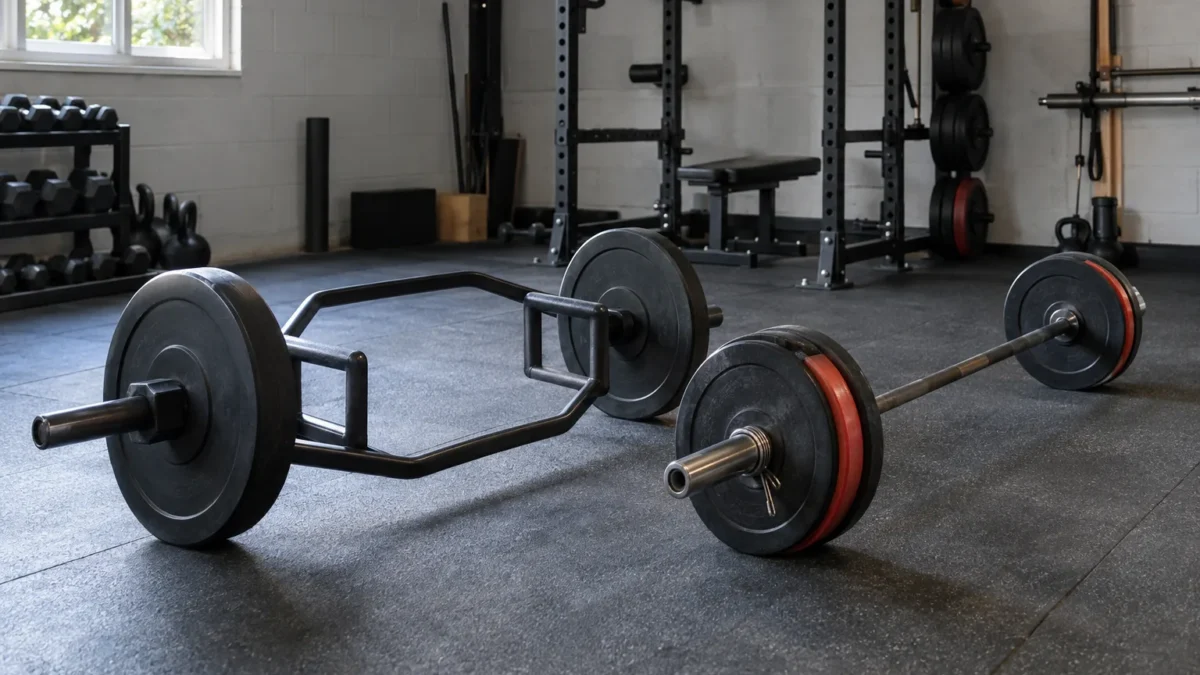
Sources: Stronger by Science, “Trap Bar Deadlifts are Underrated” (summary of Swinton et al., 2011, Journal of Strength and Conditioning Research: loads, peak hip, knee and spinal moments and joint ranges of motion); U.S. Army Combat Fitness Test deadlift event description (hex bar, 60 lb bar, 140 to 340 lb); the Amazon listings linked above for the CAP Olympic Trap Bar, Titan Fitness TITAN Series bar, Synergee Games bar and Bells of Steel Open Trap Bar (capacities, dimensions, bar weights and materials), read on October 21, 2026; our own trap bar and Olympic barbell rankings for the specifications repeated here. Capacities and dimensions are the makers’ listed figures, not independently measured. Not medical advice. Featured image: a Strong Saga illustration, not a product in this list.
Follow Strong Saga
New home gym guides, compared and ranked. Short video versions of every guide are on our channels.
 5 Home Gym Buys Ranked