
Last updated: October 20, 2026
Kettlebell vs dumbbell comes down to how you want to train. A kettlebell puts its weight below the handle, which suits swinging and hinging moves. A dumbbell spreads the weight on both sides of your hand, which suits pressing, rowing and slow, controlled strength work. For most home gyms, the better first buy is the one that fits the workouts you will actually do.
This guide compares the two on exercises, weight jumps, space and price range, then says who should start with which. We have not tested products hands-on; we compared maker spec pages, our own ranked guides and owner discussions.
Quick verdict
Most people: buy adjustable dumbbells first. Add a kettlebell for swings.
Adjustable dumbbells cover presses, rows, lunges and curls with small weight jumps in one footprint. A single kettlebell is the cheapest way to add swings and fast conditioning work. If swings and conditioning are your main goal, flip the order.
What is the difference between a kettlebell and a dumbbell?
The difference between a kettlebell and a dumbbell is where the weight sits. A kettlebell is a ball of iron or steel with a handle on top, so the load hangs below and slightly away from your hand. A dumbbell holds its weight evenly on both ends of a short bar, so it stays balanced in your grip.
- Kettlebell: off-center load, thick handle that fits two hands, made for ballistic moves such as swings, cleans and snatches.
- Dumbbell: balanced load, one-hand grip, made for presses, rows, curls and lunges.
- Adjustable dumbbell: one pair that dials through many weights; see adjustable vs hex dumbbells.
Kettlebell vs dumbbell: side-by-side comparison
| Kettlebell | Dumbbell | |
|---|---|---|
| Load position | Below and behind the handle | Balanced on both sides of the hand |
| Best for | Swings, cleans, snatches, goblet squats, carries | Presses, rows, curls, lunges, raises |
| Typical weight jumps | Often 4 kg (about 9 lb) between bells | 2.5 to 5 lb on fixed sets; 2.5 to 5 lb on many adjustables |
| Two-hand grip | Yes, on the handle | Awkward, except goblet holds |
| Floor space | One bell takes about 1 sq ft | A fixed set needs a rack; one adjustable pair needs about 2 x 2 ft |
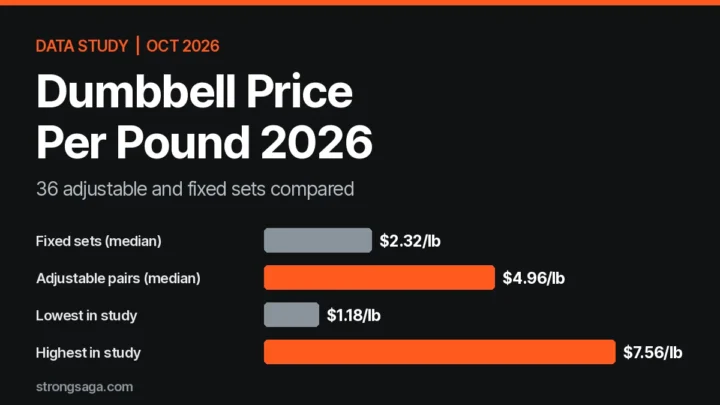
| Typical price range (new) | About $30 to $120 per cast-iron bell, by weight; competition bells cost more | About $1.50 to $3 per lb for fixed hex sets; about $200 to $500+ per adjustable pair |
Weight jumps and price ranges are typical figures from maker spec pages and the products in our guides, rounded. Price ranges are typical street prices for new home-gym gear in the US market in 2026, rounded; they are not quotes, and current prices are on each retailer’s page.
Which exercises suit each one?
Kettlebells shine on moves where the weight travels: the two-hand swing, the clean, the snatch and the Turkish get-up. The handle also makes goblet squats and farmer carries comfortable. Dumbbells shine on moves that need a balanced weight in each hand: bench presses, overhead presses, rows, split squats and isolation work such as curls and lateral raises.
- Both work well: goblet squats, deadlifts, single-arm rows, overhead presses and carries.
- Kettlebell only (practically): swings, snatches and get-ups.
- Dumbbell only (practically): heavy two-arm presses on a bench, curls, raises and other small-muscle work.
Weight jumps and progress
This is the dumbbell’s biggest edge. Many kettlebell lines step up about 4 kg (about 9 lb) at a time, for example 8, 12, 16, 20 and 24 kg, so the next bell can be a big jump on a press. Dumbbells usually step in 2.5 or 5 lb, which makes steady progress easier, and one adjustable pair can replace a whole rack of fixed weights.
Space and cost
One or two kettlebells are the cheapest way to start, and they tuck into a corner. A full fixed dumbbell set costs more and needs a dumbbell rack, while an adjustable pair costs more up front but saves floor space. Check our home gym budget calculator to see how either fits your full build.
Who should pick which?
Start with a kettlebell if you:
- want short, sweaty workouts built on swings and carries;
- have very little space or a small budget;
- already own dumbbells and want to add power and conditioning work.
Start with dumbbells if you:
- want to build strength and muscle with presses, rows and lunges;
- need small weight jumps to keep progressing;
- want one buy that covers the most exercises (an adjustable pair).
Our guides
- Best kettlebells for a home gym: cast-iron and competition bells compared and ranked.
- Best adjustable dumbbells: dial and pin-select pairs ranked by spec.
- Best 100 lb adjustable dumbbells: for heavier lifters.
- Best dumbbell racks: storage for a fixed set.
How we researched this comparison
Strong Saga compared maker spec pages, the products in our own ranked guides and owner discussions on r/kettlebell and r/homegym, read in October 2026. Kettlebell size starting points come from published guides such as Kettlebells USA’s sizing page. We did not test products hands-on.
Related guide: best adjustable weight benches.
Kettlebell vs dumbbell: FAQ
Is a kettlebell better than a dumbbell?
Neither is better overall. A kettlebell is better for swings, cleans, snatches and carries; a dumbbell is better for presses, rows, curls and slow, steady strength work, and adjustable dumbbells give you many weights in one pair.
Can kettlebells replace dumbbells?
For a full-body routine built on swings, goblet squats, presses and rows, yes, if you own a few sizes. For small weight jumps and isolation moves such as curls and lateral raises, dumbbells are easier to progress with.
What weight kettlebell should a beginner buy?
Many coaches start beginners around 8 to 12 kg (about 18 to 26 lb) for presses and 12 to 16 kg (about 26 to 35 lb) for swings, depending on strength and training history. Our best kettlebells for home gym guide covers sizes in more detail.
Should I buy adjustable dumbbells or kettlebells first?
If you want one purchase that covers the most exercises, adjustable dumbbells usually come first. If you mainly want quick conditioning workouts with swings, start with one or two kettlebells.
Are kettlebell swings bad for your back?
Swings are a hip hinge, not a squat or a back lift. Learn the hinge with a light bell and get coaching if you have back pain. This is general information, not medical advice.
Not medical advice. Check with a qualified professional before starting a new training plan, especially with an injury or health condition.
Our verdict
For most home gyms, a pair of adjustable dumbbells is the most useful first buy, and one kettlebell is the cheapest upgrade after it. If swings and conditioning are the point, start with the kettlebell.
Follow Strong Saga
New home gym guides, compared and ranked. Short video versions of every guide are on our channels.
 5 Home Gym Buys Ranked