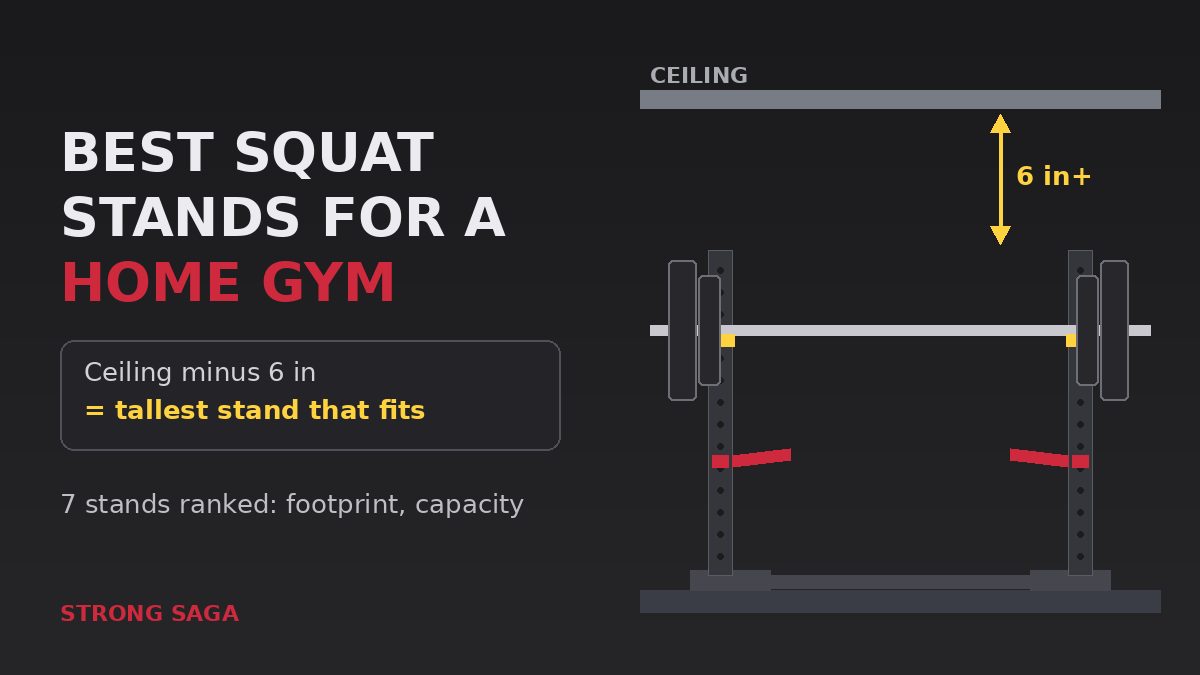
Best squat stands, short answer: the Titan X-3 Short Squat Stand is the best squat stand for most home gyms: 3×3 inch 11-gauge uprights, a 1,000 lb listed capacity and a 71.25 inch height that fits under a 7 ft ceiling. For less money the Titan T-3 Short Squat Stand (73.5 inches, 1,000 lb) is the value pick, and if you want a pull-up bar, the Titan X-3 Tall Squat Stand is the one to get.
Titan X-3 Short Squat Stand: heavy 3×3 steel, low enough for basements, 1,000 lb listed.
Tighter budget? Titan T-3 Short. Want pull-ups? Titan X-3 Tall. Renting and cannot drill? Any of the flat-base stands here, plus spotter arms.
Our 3 quick picks
Compared and ranked from published specs and current listings. Prices change, so Amazon shows today’s price.
Black Friday home gym deals: see our tracker
We compared seven squat stands on the numbers that decide whether one works in a real home gym: overall height against your ceiling, base footprint, upright steel, listed weight capacity and what safety gear actually ships in the box. Every spec below comes from the maker’s own product page or the retail listing, checked on October 23, 2026, and the ranking tells you which stand fits which room and budget. Updated October 2026.
Quick answers
What is the best squat stand for a home gym?
The Titan X-3 Short Squat Stand for most people, the Titan T-3 Short Squat Stand on a tighter budget, and the Titan X-3 Tall Squat Stand if you have an 8 ft ceiling and want a pull-up bar.
Do squat stands come with safeties?
Usually not. The Titan and Rogue stands ship with J-hooks or J-cups only, so budget for spotter arms (Titan lists its T-3 arms at $114.97 and X-3 arms at $156.97). The Yes4All adjustable stands include spotter arms.
Top pick
Titan X-3 Short Squat Stand
Best overall: 3×3 in 11-gauge uprights, 71.25 in tall, 48 x 48 in base, 1,000 lb listed.
| Product | Best for | Key spec | |
|---|---|---|---|
| Titan X-3 Short Squat Stand | Best overall | 3×3 in 11-ga, 71.25 in tall, 48 x 48 in base, 1,000 lb | Check price at Amazon |
| Titan T-3 Short Squat Stand | Best value | 2×3 in 11-ga, 73.5 in tall, 47 x 48 in base, 1,000 lb | Check price at Amazon |
| Titan X-3 Tall Squat Stand | Best with a pull-up bar | 3×3 in 11-ga, 93 in tall, pull-up bar up to 89 in, 1,000 lb | Check Amazon |
| Rogue SML-2 Monster Lite 90″ | Best premium, made in the USA | 3×3 in 11-ga, 92.25 in tall, 49 x 48 in base, 1,000 lb+ | Check price at Rogue |
| Titan T-3 Tall Squat Stand | Best tall stand on a budget | 2×3 in 11-ga, 92.5 in tall, 47 x 48 in base, 1,000 lb | Check Amazon |
| CAP Power Rack Stand | Best under $150 | 46 x 30 in base, 85 in tall, 500 lb training load | Check Amazon |
| Yes4All Adjustable Squat Rack | Best portable and adjustable | Separate adjustable stands, spotter arms included, listed to 690 lb | Check price at Amazon |
Not sure whether you need a stand at all? A squat stand is two uprights on a base. It is cheaper and smaller than a cage and leaves the bar path open, but it catches a missed rep in front of you rather than around you. If you squat heavy alone and have the room, start with our best power racks under $500 ranking; if a stand fits your space better, read on.
Squat stands compared: height, footprint and capacity
The table lists each stand’s published overall height, base size, upright steel, listed capacity, whether a pull-up bar is included and what holds or catches the bar out of the box. Prices are from each maker’s own site on October 23, 2026 and change often; the Amazon price may differ.
| Stand | Overall height | Base | Uprights | Listed capacity | Pull-up bar | Ships with | Maker price, Oct 23 2026 |
|---|---|---|---|---|---|---|---|
| Titan X-3 Short Check price | 71.25 in | 48 x 48 in | 3×3 in, 11-ga | 1,000 lb | No | J-hooks only | $354.97 |
| Titan T-3 Short Check price | 73.5 in | 47 x 48 in | 2×3 in, 11-ga | 1,000 lb | No | J-hooks only | $300.97 |
| Titan X-3 Tall Check price | 93 in | 48 x 48 in | 3×3 in, 11-ga | 1,000 lb | Yes, up to 89 in | J-hooks only | $419.97 |
| Rogue SML-2 | 92.25 in | 49 x 48 in | 3×3 in, 11-ga | 1,000 lb+ | Yes | J-cups only | See Rogue |
| Titan T-3 Tall Check price | 92.5 in | 47 x 48 in | 2×3 in, 11-ga | 1,000 lb | Yes, up to 89 in | J-hooks only | $354.97 |
| CAP Power Rack Stand Check price | 85 in | 46 x 30 in | 11 to 14 ga mix | 500 lb | Yes | Check listing | $119.99 |
| Yes4All Adjustable Check price | J-hooks 36.9 to 60.3 in | Two separate bases | Not listed | 690 lb listed | No | Spotter arms | See Amazon |
1. Titan X-3 Short Squat Stand: best overall
Titan lists the X-3 Short Squat Stand at 71.25 inches overall with 69.25 inch uprights, a 48 x 48 inch base, 3×3 inch 11-gauge steel and a 1,000 lb weight capacity. That combination is why it ranks first: it is the lowest heavy-duty stand in this comparison, so it fits under almost any 7 ft basement ceiling, yet it uses the same 3×3 tubing as full-size racks, which opens up Titan’s X-3 attachments, including spotter arms, a landmine (see our best landmine attachment rankings) and a half rack conversion kit. Westside hole spacing through the bench zone and 6 inch side spacing make it easy to set the J-hooks for both squats and bench press. The 42 x 42 inch walk-in space is wide enough for a standard Olympic bar and a flat bench.
Best for: most home gyms, low basements, and anyone who wants room to grow into a half rack later. Skip if: you want pull-ups from the same frame; get the X-3 Tall instead.
Spec source: Titan X-3 Short Squat Stand specs, checked October 23, 2026.
2. Titan T-3 Short Squat Stand: best value
The T-3 Short Squat Stand uses slightly smaller 2×3 inch 11-gauge uprights but keeps the same 1,000 lb listed capacity. Titan lists it at 73.5 inches overall on a 47 x 48 inch base, with a 41 x 42 inch walk-in and 144 lb of steel, and it was $54 cheaper than the X-3 Short on Titan’s site when we checked. For most lifters, 2×3 steel is more than strong enough; the trade-off is a smaller attachment range than the 3×3 X-3 line. We also rank it in our low ceiling power rack guide as the pick for ceilings under 7 ft.
Best for: lifters who want a heavy-duty stand at the lowest price. Skip if: you plan to add lots of rack attachments later.
Spec source: Titan T-3 Short Squat Stand specs, checked October 23, 2026.
3. Titan X-3 Tall Squat Stand: best with a pull-up bar
The tall X-3 is the same 3×3 inch 11-gauge, 1,000 lb design on 91 inch uprights, 93 inches overall, with a 42 inch long, 1.25 inch diameter pull-up bar that sets as high as 89 inches. The base stays 48 x 48 inches, so you add pull-ups without adding floor space. You need the ceiling for it: 93 inches is 7 ft 9 in, which rules out most basements and many garages with a door track overhead.
Best for: 8 ft and taller rooms where one frame should handle squats, bench and pull-ups. Skip if: your ceiling is under 8 ft; measure first.
Spec source: Titan X-3 Tall Squat Stand specs, checked October 23, 2026.
4. Rogue SML-2 Monster Lite 90″ Squat Stand: best premium, made in the USA
Rogue builds the SML-2 in the USA from two 3×3 inch 11-gauge uprights and three 2×3 inch base tubes, with 5/8 inch hardware, a 49 x 48 inch footprint and a 92.25 inch total height. Rogue lists the capacity as 1,000 lb or more and the stand weighs 157 lb. The standout detail is the hole pattern: 1 inch spacing through the bench and clean pull zone, 2 inches above and below, so you can set the J-cups and safeties very precisely. You choose a single or fat/skinny pull-up bar; the fat/skinny bar tops out at 80.5 inches and the single bar at 88 inches. It is sold by Rogue directly rather than on Amazon and is the most expensive stand here.
Best for: lifters who want a buy-once American-made stand with the widest attachment ecosystem. Skip if: price matters; the Titan X-3 Tall covers the same job for less.
Spec source: Rogue SML-2 specs, checked October 23, 2026.
5. Titan T-3 Tall Squat Stand: best tall stand on a budget
The T-3 Tall pairs 2×3 inch 11-gauge, 91 inch uprights with an adjustable 1.25 inch pull-up bar (up to 89 inches), 92.5 inches overall on a 47 x 48 inch base, at 1,000 lb listed and 140 lb. On Titan’s site it cost the same as the X-3 Short and $65 less than the X-3 Tall when we checked. It is the cheapest way in this list to get a heavy-duty stand with pull-ups.
Best for: tall rooms and tighter budgets. Skip if: you want 3×3 attachments.
Spec source: Titan T-3 Tall Squat Stand specs, checked October 23, 2026.
6. CAP Power Rack Stand: best under $150
CAP lists its Power Rack Stand at 46 inches wide, 30 inches deep and 85 inches high, with double gusseted uprights, built-in bar and plate storage, and a 500 lb maximum training load. CAP’s listing describes the tubing as an 11 to 14 gauge mix, lighter than the Titan and Rogue stands, and it was $119.99 on CAP’s own site. The shallow 30 inch base saves floor space but makes the frame easier to tip, so keep plates on the storage pegs while you lift and do not load it near its limit.
Best for: beginners with a bar and a few hundred pounds of plates. Skip if: your squat is already near 400 lb; buy a Titan stand instead.
Spec source: CAP Power Rack Stand listing, checked October 23, 2026.
7. Yes4All Adjustable Squat Rack: best portable and adjustable
This is a pair of separate, adjustable stands rather than a connected frame. Retail listings give 13 J-hook height settings (about 36.9 to 60.3 inches), 10 width settings (about 27.2 to 44.9 inches) and 8 spotter arm heights (about 23 to 36.1 inches), and the spotter arms are included. The headline capacity is 690 lb, but parts of the listing quote 600 lb, so plan around the lower figure. Because the two halves move apart, it stores in a closet and works in a rented apartment, but it is the least stable design here.
Best for: small spaces, renters and lighter training. Skip if: you are tall (check that 60 inches reaches your mid chest) or you squat heavy.
Spec source: Yes4All adjustable barbell stand listing, checked October 23, 2026.
Which squat stand should you buy?
- Ceiling under 7 ft: Titan X-3 Short (71.25 in) or Titan T-3 Short (73.5 in).
- 8 ft ceiling and you want pull-ups: Titan X-3 Tall, or the T-3 Tall to save money.
- Short ceiling but you still want pull-ups: a wall mounted pull up bar bolted into studs, which is also the only kind that takes kipping.
- Pull-ups and dips with no rack and no drilling: a freestanding power tower.
- Buy once, never upgrade: Rogue SML-2.
- Under $150 and just starting: CAP Power Rack Stand, with plates stored on the frame.
- Renting or storing it away after each session: Yes4All Adjustable, for light to moderate weights.
- Training heavy alone most days: consider a cage instead; our power rack vs squat rack comparison explains why.
Squat stand buying checklist
Run through these before you order. Most returns of squat stands come from a ceiling, a doorway or a missing safety, not from the steel.
- Ceiling height: measure at the lowest point where the stand will go (beams, ducts, garage door tracks). The stand needs its overall height plus about 2 inches to stand up during assembly. For pull-ups, add room for your head above the bar, roughly 12 inches or more depending on your size; this is an estimate, so measure your own reach.
- Overhead pressing: a standing press raises the bar well above your head. If you press in a low room, step outside the stand or measure your locked-out reach with a broomstick first.
- Footprint: the base is not the space you use. Add about 2 to 3 feet in front for walking the bar out and room on each side for loading plates. A 7 ft Olympic bar is about 86 inches long, so you need roughly 8 ft of width to load it comfortably.
- Weight capacity: pick a stand rated well above your best squat. Use the lowest number in the listing, and check the separate rating of spotter arms.
- Upright size and hole spacing: 2×3 or 3×3 inch 11-gauge steel is the heavy-duty standard. Westside or 1 inch spacing in the bench zone gives finer J-hook and safety settings.
- Safeties: if only J-hooks ship in the box, buy spotter arms at the same time and set them before the first heavy set.
- Bolting and floor: decide whether you can bolt to concrete. If not, choose a wide flat base, store plates low and put the stand on rubber flooring so it does not slide.
- Attachments: if you may want a landmine, dip bars or a half rack later, stay in a 3×3 system like Titan X-3 or Rogue Monster Lite.
Want the numbers for your own room? The free power rack ceiling height calculator checks your ceiling and height against a rack or stand in a few seconds.
When a squat stand is not the right buy
If you cannot spare a 4 x 4 foot base, a wall-mounted rack that folds flat is the better fit; see our best folding squat rack ranking. If you want a rack and a bench delivered together, our best squat rack and bench combo guide compares sets that ship as one order. And if you train alone and heavy, a four-post cage gives the most protection; the best power racks under $500 hub ranks eight of them with the same ceiling and footprint checks used here.
How we ranked these squat stands
We compared each stand on published specifications only: overall height, base footprint, upright size and gauge, listed capacity, included safety gear, hole spacing and price on the maker’s own site. Stands with heavier steel, a higher listed capacity and a lower height for the same strength ranked higher, because they suit the most rooms and lifters. Budget and portable stands are included because they answer real constraints, with their limits stated plainly. We did not use the products ourselves; where a listing gives two different numbers, we report the lower one.
Related guide: best adjustable weight benches.
Related guide: best barbell for a home gym.
Frequently asked questions
Are squat stands safe for lifting alone?
Yes, if you add spotter arms and set them just below the bottom of your rep. Most squat stands ship with J-hooks only, which hold the bar but will not catch it, so a failed squat or bench press needs safeties in place before your first heavy set. If you train alone often and have the room, a full power rack with pin safeties is still the safer place to miss a lift.
Is a squat stand as good as a power rack?
For squats, presses and bench press with spotter arms, a good squat stand does the same job in less space and for less money. A power rack wins on safety coverage, because its safeties sit on both sides of you, and on attachments. Our power rack vs squat rack comparison explains the trade in detail.
What ceiling height do I need for a squat stand?
The stand itself needs its overall height plus about 2 inches so you can stand the uprights up during assembly. A short stand around 71 to 74 inches fits most 7 ft basements. A tall stand with a pull-up bar is about 92 to 93 inches, so plan on roughly an 8 ft ceiling at minimum, and more if you want to do pull-ups without hitting your head.
Do squat stands need to be bolted down?
Bolting to concrete is the safest option and some makers recommend it, but many squat stands with wide flat bases are used freestanding. Load plate storage low on the base, keep the bar centered when you rack it, put the stand on rubber flooring and never do kipping pull-ups on an unbolted tall stand.
Can you bench press on a squat stand?
Yes. Lower the J-hooks so the bar sits at arm’s length above your chest while you lie on the bench, and set spotter arms an inch or two below your chest. Westside hole spacing (holes 1 or 2 inches apart through the bench zone) on the Titan and Rogue stands makes it easier to get both heights right.
How much weight can a squat stand hold?
Heavy-duty 11-gauge stands from Titan and Rogue are listed at 1,000 lb or more, far beyond what most home lifters will load. Budget stands are listed lower: CAP lists a 500 lb maximum training load for its Power Rack Stand. Always use the lowest number in a listing, and remember spotter arms often carry their own, lower rating.
What is the difference between a squat stand and a half rack?
A squat stand is two uprights on a base with J-hooks. A half rack adds a second pair of uprights or long arms behind or in front of you, so spotter arms have more support and plates can be stored on the frame. Several stands, including the Titan X-3, can be converted to a half rack with a kit.
Are separate (independent) squat stands safe?
They are fine for light and moderate weights, warm ups and pausing the bar between sets, but they move more easily than a connected stand because each upright stands on its own small base. Keep the bar centered, use the included spotter arms, and step up to a connected stand once your squat passes the weight the listing allows.
Follow Strong Saga
New home gym guides, compared and ranked. Short video versions of every guide are on our channels.
 5 Home Gym Buys Ranked